How Much to Feed a Pomeranian: Feeding Chart by Age and Weight
General nutrition information compiled from product labels and published sources, not veterinary advice. Your veterinarian is the right person to choose a diet for your dog, especially one with a health condition.
Most owners ask how much a Pomeranian should eat before they ask which food to buy. It is a fair order. A Pomeranian is tiny, so a small mistake in the scoop adds up fast.
PetMD lists the adult Pomeranian at about 3 to 7 pounds. At that size, an extra quarter cup a day is a big share of the daily calories. This guide shows how to find a sensible starting amount from a food's own label. It also covers how to check whether that amount is working.
One point before we start. A label guide is a starting point, not a prescription. A veterinarian sets the amount for an individual dog.
What You Need
- The bag, can or tray your Pomeranian eats now, with the feeding guide and calorie statement.
- A set of standard dry measuring cups, or better, a small kitchen scale that reads in grams.
- Your dog's current weight. A bathroom scale works if you weigh yourself holding the dog, then subtract your own weight.
- A notebook or phone note for weight, amounts and treats.
- A list of every treat, chew and topper your dog gets in a day.
Step 1: Confirm Your Pomeranian's Life Stage
Life stage decides which food and which label table you use. PetMD advises feeding adult food to dogs at least 1 year old. Before that, a puppy food or an all life stages food is the usual choice.
Check the AAFCO statement on the package. It should say the food is formulated to meet the AAFCO Dog Food Nutrient Profiles for your dog's stage. For example, the Royal Canin Pomeranian Adult formula states it meets the profiles for maintenance. The VICTOR Hi-Pro Plus Small Breed Adult states it meets them for all life stages, except growth of large size dogs.
PetMD also lists senior Pomeranians as needing two to three meals a day, the same as adults. Some brands make a 7+ formula. Hill's Science Diet, for instance, offers Adult 7+ Small & Mini recipes. Whether your dog needs one is a question for your vet.
Step 2: Weigh Your Dog and Find the Right Row
Weigh your Pomeranian on the same scale each time, ideally at the same time of day. Write the number down in pounds.
Every brand builds its chart from weight. Some add activity level or age. That is why a Pomeranian feeding chart from one brand cannot be copied onto another brand's food. Cups of different foods hold different calories.
Step 3: Read the Label Guide for Your Food
The table below uses real label data from the brand pages. It is not a universal chart. Each row cites the product whose guide it comes from. The calorie figures in the last column are simple arithmetic: the label's amount multiplied by the label's kcal per cup or can. They show how different foods compare. They are not a daily target.
| Product and label source | Dog size and stage in the label example | Label amount per day | Label calories | Approx. calories from that amount |
|---|---|---|---|---|
| Royal Canin Breed Health Nutrition Pomeranian Adult (Royal Canin US product page) | 2.2 lb adult, low activity | 1/4 cup (24 g) | 352 kcal ME per cup, calculated | About 88 kcal |
| Hill's Science Diet Puppy Small & Mini Chicken & Brown Rice (Hill's Pet US product page) | 2 lb puppy, 4 to 9 months | 3/8 cup (40 g) | 418 kcal per cup | About 157 kcal |
| Hill's Science Diet Adult 7+ Small & Mini Chicken & Brown Rice, dry (Hill's Pet US product page) | 2 lb senior | 1/4 cup (the chart runs up to 1 2/3 cups for a 25 lb dog) | 359 kcal per cup | About 90 kcal |
| Hill's Science Diet Adult 7+ Small & Mini Chicken & Barley, wet 5.8 oz can (Hill's Pet US product page) | 2 lb senior | 1/2 can (the sample amounts run up to 3 1/2 cans for a 25 lb dog) | 174 kcal per can | About 87 kcal |
| VICTOR Hi-Pro Plus Small Breed Adult (VICTOR Pet Food product page) | 5 lb dog, all life stages formula | 0.5 cup (chart uses an 8 oz measuring cup) | 360 kcal per cup | About 180 kcal |
| Freshpet Vital Small Breed Chicken Recipe (Freshpet product page) | 5 to 10 lb dog | 1/2 to 3/4 cup | 294 kcal per cup | About 147 to 221 kcal |
Read the table with care. The label examples start at 2 lb, which is below the 3 to 7 lb PetMD gives for adult Pomeranians. A small adult may sit between two rows. Use your own brand's full chart, not the closest row in this one.
Several products in the table do not publish an amount for every weight in the page text we compared. The Royal Canin Small Puppy page keeps its daily amounts in an image and offers a calculator. The Royal Canin X-Small Adult page also points to a feeding calculator. The Freshpet Small Dog Bite Size Chicken Recipe says its quantities can be fed as one meal daily or split into two. For any of these, check the brand's own page for the exact amount for your dog's weight.
The wide spread in calories also shows why two dogs of the same weight can eat very different volumes. The Hill's puppy food has 418 kcal per cup. The Freshpet recipe has 294 kcal per cup. A cup is not a unit of nutrition.
Step 4: Measure Accurately
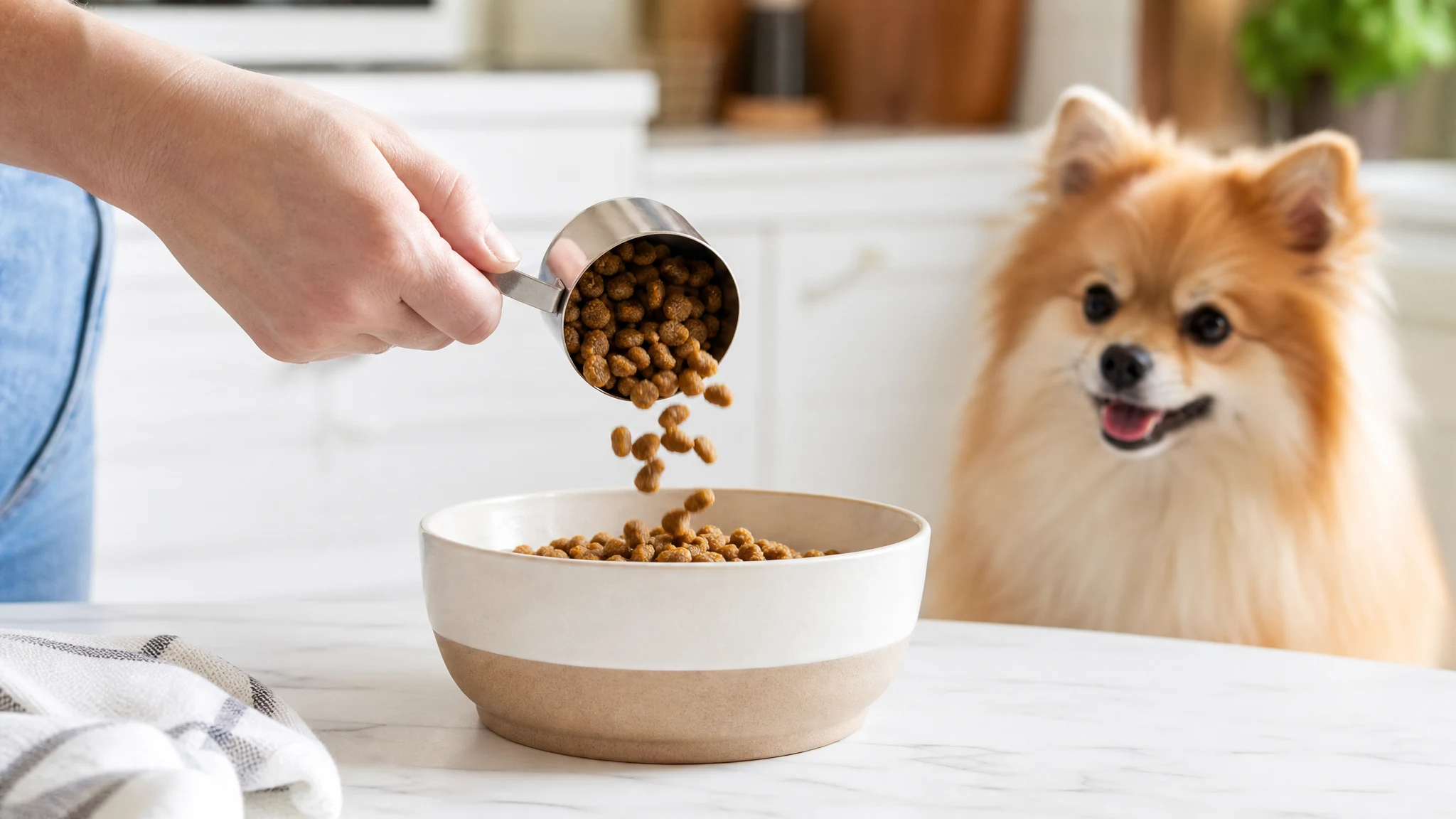
Scoops drift. A heaped cup can hold noticeably more than a level one, and with a 1/4 cup daily amount the error is large in proportion.
- Use a real measuring cup, not a coffee mug or the scoop that came free with something else.
- Level the cup with a flat edge.
- If the label lists grams, as the Royal Canin Pomeranian Adult guide does with 24 g, weigh the food on a kitchen scale instead.
- Note that VICTOR says its chart uses a standard 8 oz measuring cup. Use the same size.
Step 5: Split the Daily Amount into Meals
The label amount is per day, not per meal. Divide it across the day.
PetMD recommends frequent meals for Pomeranians because the breed has a higher than average risk of hypoglycemia, or low blood sugar. Puppies get multiple meals a day. Adults and seniors get two to three. The site pomeranian.org, a secondary breed information site, says most puppy hypoglycemia cases come from insufficient or low-quality food.
So a puppy's schedule is not the place to experiment. If your puppy seems weak, wobbly or unusually sleepy, call your veterinarian rather than adjusting the bowl.
Step 6: Count Treats, Chews and Toppers
PetMD advises that treats, chews and toppers count toward daily calories, to avoid obesity. In a dog that eats about 90 to 180 kcal of kibble a day, as the label examples above suggest, a few treats are not trivial.
Try this routine:
- Write down every treat for three days.
- Check the calorie statement on each treat package.
- If the treats add up, trim the meal slightly to make room, or use part of the dog's own kibble as rewards.
Ask your vet how much room to leave for extras. The right share depends on the individual dog.
Step 7: Check Body Condition Every Two Weeks
The scale tells you weight. Body condition scoring tells you whether that weight is the right shape. Many veterinarians use a standard scoring chart and can show you where your dog falls. You can do a simple home check between visits.
- Feel the ribs. Run your hands along the sides of the chest. You should feel the ribs under a thin layer of padding, without pressing hard. Under all that fluff, hands matter more than eyes.
- Look from above. A healthy dog usually shows a slight waist behind the ribs. If the body looks like a straight tube or bulges outward, ask your vet about weight.
- Look from the side. The belly should tuck up a little between the ribs and the hind legs rather than hanging level or sagging.
- Feel the spine and hips. They should not stick out sharply or be buried.
A Pomeranian's thick double coat hides body shape. Many owners are surprised by how thin or heavy the dog is underneath. That is why touch matters more than looking.
PetMD lists collapsing trachea among the breed's health problems. It is not a diet-driven condition, but extra weight is something to discuss with your veterinarian for any dog with breathing concerns.
Step 8: Adjust for Activity, Age and Weight Changes
Brand charts often offer a range for a reason. The Royal Canin Pomeranian Adult guide, for example, splits amounts by activity level. A calm lap dog and a dog that runs the yard for an hour do not need the same food.
Use the label as a start, then watch the results over a few weeks:
- If your dog is getting heavier and ribs are harder to feel, ask your vet about trimming the daily amount.
- If your dog looks lean, ribs are very easy to see, or energy dips, ask your vet before raising it.
- Change amounts in small steps, not big jumps.
- Switch foods gradually if you change brands. Calories per cup differ a lot, so never swap cup for cup without checking the new label.
Hill's says on its small and mini pages to adjust amounts as necessary to maintain optimal weight and to ask your veterinarian if you are unsure. That advice applies to any food.
Common Mistakes to Avoid
- Using a chart for the wrong food. Cups of one food are not cups of another.
- Feeding to the dog's expected adult size on a puppy formula. The Royal Canin Small Puppy page is written for dogs with an expected adult weight of 9 to 22 lb. A Pomeranian is smaller than that range, so the X-Small line may fit better. Confirm with your vet.
- Free feeding. A bowl that is always full hides how much your dog really eats.
- Forgetting extras. Chews, dental treats and toppers all add calories.
- Cutting meals sharply for a puppy. Given the hypoglycemia risk PetMD describes, talk to your vet first.
- Relying on looks. A fluffy coat hides both weight gain and weight loss.
- Treating a label as a medical plan. Food does not treat or prevent disease. If your dog has a health problem, your vet decides on diet, including any prescription food.
What to Expect
If the starting amount suits your dog, you may see steady weight over several weeks, a coat in good condition and regular energy. You may also find the ribs stay easy to feel and a waist stays visible.
Results vary. Age, activity, spay or neuter status, health conditions and the food itself all play a part. Some dogs need less than the label suggests and some need more. A stable weight and a good body condition score are better signs than any chart.
Weigh your dog every couple of weeks at first, then monthly once things settle. Bring the notes to your next vet visit. A vet can read your log and set the daily amount for your dog.
How We Built This Table
We compared label data from the brand pages named above. We did not run feeding trials or taste tests, and we did not feed any of these foods to dogs ourselves. The calorie arithmetic is ours and is only meant for comparing foods. It is not a daily target for your dog.
For a side-by-side look at ingredients, AAFCO statements and calories, see our Pomeranian foods compared by label data.
Quick Checklist
- Confirm life stage and the AAFCO statement.
- Weigh your dog on the same scale each time.
- Find your own food's feeding guide, not another brand's.
- Measure by level cup or by grams.
- Split the daily amount into frequent meals.
- Count treats, chews and toppers.
- Check body condition by touch every two weeks.
- Adjust in small steps and ask your veterinarian.
Sources
- PetMD Pomeranian breed page
- pomeranian.org breed information
- Royal Canin Breed Health Nutrition Pomeranian Adult
- Royal Canin Small Puppy
- Royal Canin Size Health Nutrition X-Small Adult
- Hill's Science Diet Puppy Small & Mini
- Hill's Science Diet Adult 7+ Small & Mini, dry
- Hill's Science Diet Adult 7+ Small & Mini, canned
- VICTOR Hi-Pro Plus Small Breed Adult
- Freshpet Vital Small Breed Chicken Recipe
- Freshpet Small Dog Bite Size Chicken Recipe