Best Dog Food for Pomeranians: Foods Compared by Label Data
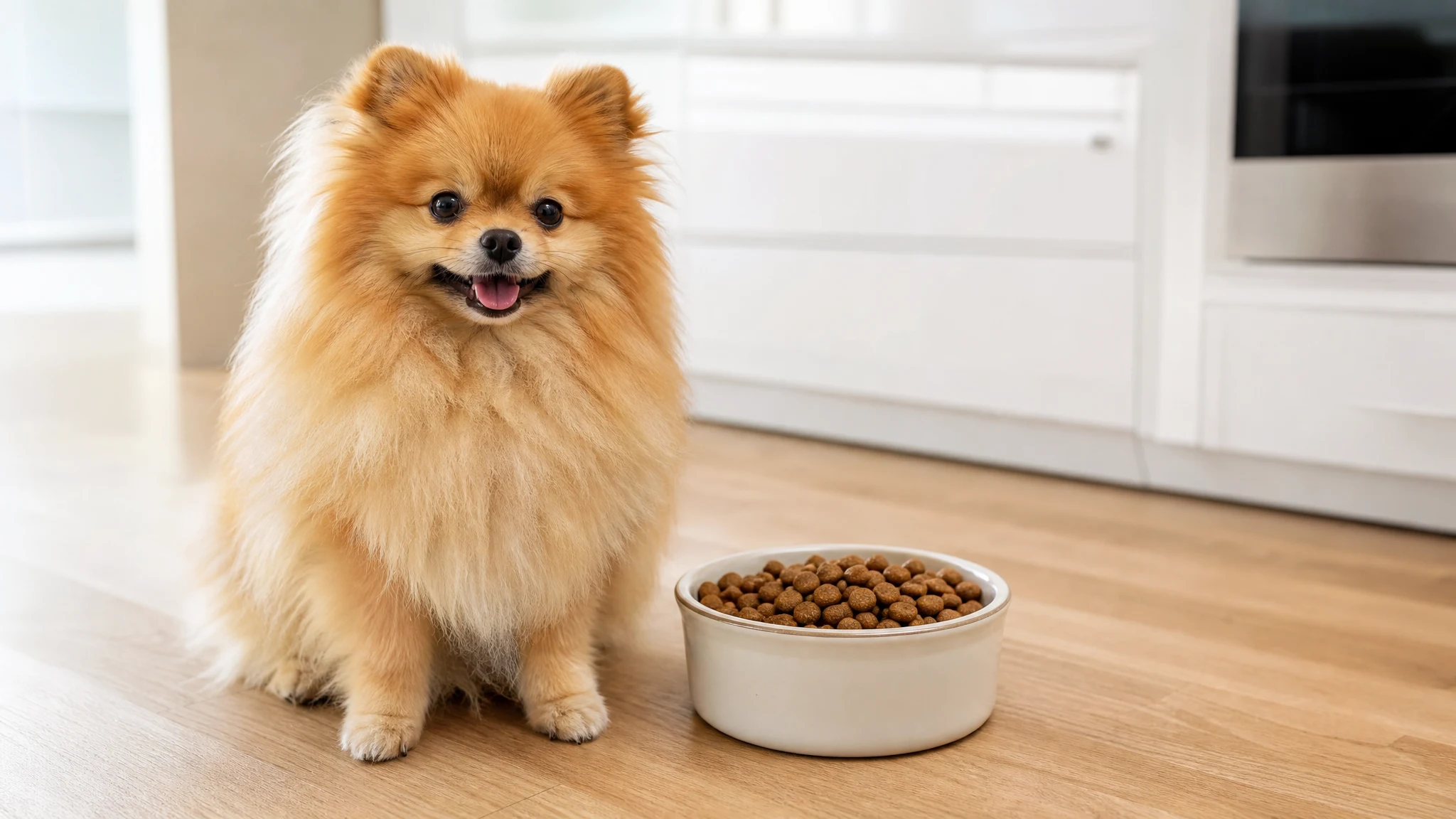
General nutrition information compiled from product labels and published sources, not veterinary advice. Your veterinarian is the right person to choose a diet for your dog, especially one with a health condition.
A Pomeranian eats very little food, so each cup and each calorie matters. That makes the choice of food more consequential than it first looks. A few extra kibbles a day is a real percentage of a 5 pound dog's intake.
This guide is a label-reading exercise. It looks at what the brands themselves publish for a set of foods that suit small dogs. Then it shows who each label seems to fit. It does not crown a single winner, because the best food for Pomeranians depends on age, weight, budget and what your veterinarian says about your own dog.
How these foods were compared
Here is the method, stated plainly. We compared label data published on each brand's own product page. That means the AAFCO nutritional adequacy statement, the life stage, the guaranteed analysis (protein, fat, fiber), calories per cup, the first five ingredients and any kibble size information.
We did not run feeding trials. We did not taste test anything. We did not feed these foods to dogs, and we make no claim about how a particular Pomeranian will do on any of them. A label tells you what is in the bag and what the maker says it is formulated for. It does not tell you how a food performs in your dog.
Some label details were not available to us. Where a number is missing, we say so and suggest checking the brand. We also do not compare prices. Prices change by store, bag size and region, and we will not guess at them.
What to know about Pomeranian diets first
A few breed points shape what to look for on a label. They come from the PetMD Pomeranian breed page and from pomeranian.org, a secondary breed information site. Neither is a breed club, so treat them as general background.
- Size. PetMD gives the adult weight as 3 to 7 pounds, which puts the breed in the toy category. Other sites give different ranges, so your own dog may vary.
- Lifespan. PetMD lists 12 to 16 years. That is a long time to be eating the same type of food, and your dog will pass through puppy, adult and senior stages.
- Adult food timing. PetMD advises adult food for dogs at least 1 year old.
- Blood sugar. PetMD notes a higher than average risk of hypoglycemia (low blood sugar) in the breed, especially in puppies. It recommends a high-quality food that meets AAFCO standards and frequent meals. Puppies get several meals a day. Adults and seniors get two to three. The pomeranian.org breed page says most puppy hypoglycemia cases are linked to insufficient or low-quality food. Any low blood sugar episode is a reason to call your veterinarian, not to switch brands on your own.
- Calories add up. PetMD advises that treats, chews and toppers count toward daily calories, to avoid obesity. In a dog this small, a single treat can be a large share of the day's food.
- Teeth and airway. PetMD lists dental disease and collapsing trachea among the breed's health problems. Neither is something a bag of food fixes, but both are reasons to keep a Pomeranian lean and to talk to your veterinarian about dental care.
- Large-breed growth rules do not apply. A toy breed is far below the AAFCO 70 pound large-size threshold. The large-breed puppy calcium limits are not a concern here.
What to look for on a Pomeranian food label
The AAFCO statement
This is the most important line on the bag. Look for wording that the food is formulated to meet the AAFCO Dog Food Nutrient Profiles, or that AAFCO feeding tests substantiate it, for a stated life stage. "Maintenance" means adult dogs. "Growth" covers puppies. "All life stages" covers both, and often carries an exception for growth of large size dogs, which is not a concern for a Pomeranian.
Two phrasings appear in the foods below. Some say the food is formulated to meet the profiles. Hill's says animal feeding tests using AAFCO procedures substantiate its adult small breed food. Those are different routes to the same kind of statement, and both are common. A food with no statement at all is a red flag for a dog's main diet.
Life stage match
Pick the stage that matches your dog. A puppy needs a growth or all life stages food. An adult can eat a maintenance food. Pomeranian puppies deserve extra care because of the blood sugar point above.
Calories per cup
Calories per cup lets you compare foods fairly and plan portions. Foods in this guide range from about 244 to 418 kcal per cup, and wet and fresh foods have far less per cup because of their water content. A small cup measure is a blunt tool for a 5 pound dog, so many owners weigh food on a kitchen scale instead. Ask your veterinarian what suits your dog.
Protein, fat and fiber
These are the guaranteed analysis numbers. For dry food, they are typically stated as minimums for protein and fat and a maximum for fiber. Compare like with like. Wet and fresh foods list lower percentages because they contain water, so a fresh food with 8 percent protein is not necessarily lower in protein than a kibble with 25 percent. Only a dry matter comparison would show that, and few product pages give one.
The first five ingredients
Ingredient lists are in order of weight before cooking. The first five tell you the main building blocks. A named protein such as chicken is clearer than a vague term. "Chicken by-product meal" is a named source, but you can decide for yourself how you feel about it. Remember that fresh ingredients like chicken contain a lot of water, which shifts their position in the list.
Kibble size
A toy breed has a small mouth, so brands often design smaller pieces. Few of the product pages we read give an actual size in millimeters. They use phrases like "smaller kibble shape" or "very small kibble." If kibble size matters for your dog, ask the brand for the dimensions and buy a small bag first.
Foods compared by label data
The table shows dry foods only, since those share the same measures. Wet and fresh foods are covered separately below. Hill's pages give dry matter averages rather than guaranteed minimums, so we mark those as averages.
| Food | Stage | Protein | Fat | Fiber | Calories per cup |
|---|---|---|---|---|---|
| Royal Canin Breed Health Nutrition Pomeranian Adult | Adult | 24% min | 14% min | 3.6% max | 352 kcal ME (calculated) |
| Royal Canin Size Health Nutrition X-Small Adult | Adult, 10 months to 8 years | 22% min | 16% min | 3.5% max | 369 kcal ME (calculated) |
| Royal Canin Small Puppy | Puppy | 29% min | 18% min | 3.9% max | 349 kcal ME (calculated) |
| Hill's Science Diet Adult Small & Mini Chicken & Brown Rice | Adult | 25% (dry matter avg) | 15.3% (avg) | 1.5% (avg) | 357 kcal |
| Hill's Science Diet Puppy Small & Mini Chicken & Brown Rice | Puppy | 28.9% (avg) | 19.7% (avg) | 2.3% (avg) | 418 kcal |
| Hill's Science Diet Adult 7+ Small & Mini Chicken & Brown Rice | Senior | 21.5% (avg) | 15% (avg) | 3.7% (avg) | 359 kcal |
| VICTOR Hi-Pro Plus Small Breed Adult | All life stages | 30% min | 14% min | 5% max | 360 kcal |
| VICTOR Hi-Pro Plus Small & Medium Breed Puppy | All life stages | 30% min | 18% min | 5% max | 383 kcal |
Because the Hill's numbers are averages and the others are minimums or maximums, do not read across the two groups as if they were the same measure. Treat the table as a way to see rough differences, not a ranking.
Picks by situation
Below, each pick is described only by what the brand's page shows. None is a recommendation for your individual dog. They are starting points for a conversation with your veterinarian.
Adult Pomeranians
Royal Canin Breed Health Nutrition Pomeranian Adult is the only food here made specifically for the breed. The label says it is formulated to meet the AAFCO Dog Food Nutrient Profiles for maintenance. The first five ingredients are brewers rice, corn, chicken by-product meal, chicken fat and oat groats. It lists 24 percent protein minimum, 14 percent fat minimum and 3.6 percent fiber maximum, at 352 kcal ME per cup (calculated). The page says the smaller kibble shape suits a small dog's jaws but does not give a size. Its feeding table goes by weight and activity level. As an example, a 2.2 pound dog at low activity is listed at 1/4 cup (24 g). It suits owners who want a breed-named food built around maintenance and are comfortable with a grain-based recipe.
Royal Canin Size Health Nutrition X-Small Adult targets dogs with adult weights up to 8 pounds, from 10 months to 8 years of age. It is formulated to meet AAFCO maintenance levels. It has 22 percent protein minimum, 16 percent fat minimum, 3.5 percent fiber maximum and 369 kcal ME per cup (calculated). The first five ingredients are brewers rice, corn, chicken by-product meal, chicken fat and corn gluten meal. The page describes very small kibble for the miniature jaw. It says no feeding amounts in its text and points to a feeding calculator. A 3 to 7 pound Pomeranian fits within its stated size range.
Hill's Science Diet Adult Small & Mini Chicken & Brown Rice leads with chicken, then brown rice, whole grain wheat, whole grain corn and brewers rice. Hill's states that AAFCO feeding tests substantiate it for adult maintenance. It gives dry matter averages of 25 percent protein, 15.3 percent fat and 1.5 percent crude fiber, and 357 kcal per cup. The page says only that the kibble texture is designed for a small dog's preferences. It tells owners to adjust amounts to keep an optimal weight and to ask a veterinarian if unsure. It suits owners who value a food backed by feeding test wording on the label.
Puppies
Pomeranian puppies are tiny, and their blood sugar risk makes consistent, frequent meals of a complete food important. Your veterinarian should set the schedule.
Hill's Science Diet Puppy Small & Mini Chicken & Brown Rice says AAFCO feeding tests substantiate it for growing puppies. The first five ingredients are chicken, whole grain oats, brown rice, chicken meal and chicken fat. Dry matter averages are 28.9 percent protein, 19.7 percent fat and 2.3 percent fiber, at 418 kcal per cup. That is the most energy dense dry food in this guide, which matters when you measure portions. Its growth feeding table lists 3/8 cup (40 g) per day for a 2 pound dog at 4 to 9 months. Treat that as a starting point only.
Royal Canin Small Puppy is formulated to meet AAFCO levels for growth, including growth of large size dogs. It has 29 percent protein minimum, 18 percent fat minimum, 3.9 percent fiber maximum and 349 kcal ME per cup (calculated). Its stated expected adult weight range is 9 to 22 pounds, which is above a Pomeranian's 3 to 7 pounds. Royal Canin's X-Small line may fit better, so confirm with your veterinarian which suits your puppy. Its daily amounts are in an image and the page offers a feeding calculator.
VICTOR Hi-Pro Plus Small & Medium Breed Puppy is labeled for all life stages except growth of large size dogs. It lists 30 percent protein minimum, 18 percent fat minimum, 5 percent fiber maximum and 383 kcal per cup. The first five ingredients are beef, chicken, beef meal, chicken meal and whole grain sorghum. The page says the kibble size suits small and medium breeds but does not give a size, so ask VICTOR about the dimensions for a toy puppy.
Seniors
PetMD suggests two to three meals a day for adults and seniors. The senior foods here come from Hill's and are labeled for small and mini breeds age 7 and up.
Hill's Science Diet Adult 7+ Small & Mini Chicken & Brown Rice (dry) uses chicken, brown rice, whole grain wheat, whole grain corn and brewers rice as its first five ingredients. Dry matter averages are 21.5 percent protein, 15 percent fat and 3.7 percent fiber, at 359 kcal per cup. The page describes nibble size kibble. Its feeding chart runs from 1/4 cup for a 2 pound dog to 1 2/3 cups for a 25 pound dog. The AAFCO wording is about maintenance of adult dogs.
Any food change for an older dog is a conversation to have with your veterinarian, especially if your dog has a health condition. Label data cannot tell you what a senior dog needs medically.
Weight control
None of the foods we compared is labeled as a weight management formula, and we will not suggest one is. What the labels do give you is calories per cup. In this group, the dry foods run from 349 to 418 kcal per cup. The lowest is Royal Canin Small Puppy at 349, though that is a puppy food, so it is not a sensible choice for an adult. Among adult and senior dry foods, Royal Canin Pomeranian Adult is lowest at 352, followed by Hill's Adult Small & Mini at 357 and Hill's Adult 7+ at 359.
Those gaps are small. How much you feed, and how many treats count toward the day, will matter far more than which of these bags you pick. PetMD says treats, chews and toppers count toward daily calories. If your Pomeranian is gaining weight, ask your veterinarian to set a target and a daily amount. Prescription diets for weight or any health condition are something only a veterinarian prescribes.
Sensitive stomachs
We cannot point to a food on this list that is labeled for sensitive stomachs, and we will not suggest that any of them solves digestive trouble. If your Pomeranian has vomiting, loose stools or poor appetite, see your veterinarian first. In a dog this small, a stomach upset can become serious quickly, partly because of the blood sugar risk.
If your veterinarian wants you to try a different food, ingredient lists are a practical tool. Compare the first five ingredients across foods and change foods gradually as your veterinarian directs.
Wet food
Hill's Science Diet Adult 7+ Small & Mini Chicken & Barley Entree is the one wet food in this guide. The first five ingredients are water, chicken, cracked pearled barley, pork liver and whole grain corn. Dry matter averages are 21.9 percent protein, 16 percent fat and 2 percent fiber. Each 5.8 ounce can is 174 kcal. That is per can, not per cup. Sample daily amounts on the page run from 1/2 can for a 2 pound dog to 3 1/2 cans for a 25 pound dog. The page says to adjust amounts to maintain optimal weight.
Wet food is easy to compare by calories per can. Because it is mostly water, it fills a small bowl quickly for few calories. Some owners use it as a topper, but toppers still count toward the daily calorie total.
Fresh food
Fresh foods are cooked, refrigerated or frozen, and they come in portions. Three appear here.
- Freshpet Small Dog Bite Size Chicken Recipe is formulated to meet AAFCO levels for all life stages except growth of large size dogs. The first five ingredients are chicken, chicken liver, carrots, cranberries and eggs. It lists 16 percent protein minimum, 12 percent fat minimum, 1.5 percent fiber maximum and about 267 kcal per cup (calculated). The page says the portion can be fed as one meal or divided into two meals a day.
- Freshpet Vital Small Breed Chicken Recipe with Carrots, Sweet Potatoes & Cranberries is labeled for all life stages. We could only confirm part of its AAFCO statement, so check the full wording, including any large-size growth exception, with Freshpet. Its first five ingredients are chicken, chicken liver, carrots, sweet potatoes and cranberries. It has 16 percent protein minimum, 12 percent fat minimum and 1.5 percent fiber maximum, at 294 kcal per cup. Its page lists 5 to 10 pound dogs at 1/2 to 3/4 cup per day.
- Nom Nom Chicken Cuisine is formulated for all life stages including growth of large size dogs. The first five ingredients are chicken, sweet potatoes, squash, spinach and dicalcium phosphate. It lists 6.5 percent protein minimum, 4.5 percent fat minimum and 3.5 percent fiber maximum, at about 244 kcal per cup (calculated). It is not a small breed formula. Its page calls its daily recommendations a guide that may vary with age, weight and activity.
- JustFoodForDogs Chicken & White Rice Recipe is also labeled for all life stages including growth of large size dogs. The first five ingredients are chicken, long-grain white rice, long-grain brown rice, carrots and kale. It lists 8 percent protein minimum, 3 percent fat minimum and 1 percent fiber maximum. The page gives 43 kcal ME per ounce but no per-cup figure. It is not a small breed formula either.
Fresh foods do not use kibble, so kibble size is not an issue. Their trade-offs are storage in the refrigerator or freezer and portioning. Because they are moist, their percentages cannot be compared directly with dry foods. Some of the product pages did not state whether the food is grain free, so check the brand if that matters to you.
Budget and price points
You may expect "top picks at different price points" here. We cannot give them, because the brand pages we read did not state prices we could verify, and prices vary widely by bag size, store and region. We will not guess.
What you can do is compare cost per day rather than cost per bag. Take the calories per cup, the label's feeding amount for your dog's weight, and the price you see on the brand's own site. For a 5 pound dog, the difference between foods is often smaller per day than the sticker suggests, since the daily portion is so small. Fresh foods tend to cost more to feed than dry, but we cannot show you exact figures.
Red flags to avoid
- No AAFCO statement. If a bag does not say it is complete and balanced for a life stage, it is not a good main diet. Treats and toppers are different, but they should not make up most of the day's food.
- The wrong life stage. Feeding an adult food to a young puppy, or the reverse, misses what the label was formulated for. Ask your veterinarian when to switch.
- Health claims on the front of the bag. No food prevents or cures hip problems, allergies, heart disease or bloat. If a marketing line implies otherwise, be skeptical. Your veterinarian decides what is right for an individual dog.
- Vague ingredient names. Look for named protein sources rather than generic terms.
- Portion guides you cannot follow. A toy breed needs a guide that goes down to the 3 to 7 pound range. Some charts start at 2 pounds, and some run to 25 pounds or more. Check that your dog's weight appears on the chart.
- Unclear kibble size. If the brand cannot tell you the piece size, you are guessing about whether your dog can chew it comfortably.
- Very low quality or insufficient food for puppies. The pomeranian.org breed page links most puppy hypoglycemia cases to insufficient or low-quality food, so skimping here carries a particular risk in this breed.
A note on grain-free diets and DCM
You may see grain-free foods promoted or warned against. The FDA's Center for Veterinary Medicine has investigated a potential link between certain diets and canine dilated cardiomyopathy (DCM). Its latest update is dated December 23, 2022, and it says it does not intend to release further public updates until there is meaningful new scientific information. The investigation concerned grain-free diets high in peas, lentils or potatoes.
All of the dry foods compared here are listed as not grain free. For the fresh foods, grain-free status was not stated on the pages we read. This is not a verdict on any food. If you have concerns about diet and heart health, your veterinarian is the right person to ask.
Where to buy
We do not link to stores, and we do not sell anything. The simplest route is the brand's own site. Each product name above links to the brand page, where you can check the current label, feeding guide and the brand's own information on where it is sold.
When buying a bag, check the packaging for the life stage and AAFCO statement, and look at the date code on the bag. For a dog this small, a smaller bag is often sensible, because it gets used up before it goes stale. If you are trying a new food, start with a small bag and introduce it gradually. Your veterinarian can advise on the pace.
Buying from your veterinarian's clinic is also an option for some brands. Ask what they carry and why they suggest it.
How to put it together
- Decide the life stage: puppy, adult or senior, and confirm it with your veterinarian.
- Check the AAFCO statement matches that stage.
- Compare calories per cup and the first five ingredients.
- Check that the feeding guide covers your dog's weight, and treat it as a starting point.
- Ask the brand about kibble size if your dog has trouble with chewing.
- Count treats and toppers in the daily calories.
- Watch your dog's weight and energy, and report changes to your veterinarian.
There is no single best food for Pomeranians. There is a food whose label fits your dog's stage and size, which your dog eats well and which keeps your dog at a healthy weight under your veterinarian's guidance. The label data above gives you a fair way to begin narrowing down your choices.
Sources
- PetMD, Pomeranian breed page
- pomeranian.org, Pomeranian breed information
- FDA Center for Veterinary Medicine, investigation into potential link between certain diets and canine dilated cardiomyopathy
- Royal Canin, Pomeranian Adult Dry Dog Food
- Royal Canin, X-Small Adult Dry Dog Food
- Royal Canin, Small Puppy Dry Dog Food
- Hill's Pet, Science Diet Adult Small & Mini
- Hill's Pet, Science Diet Puppy Small & Mini
- Hill's Pet, Science Diet Adult 7+ Small & Mini (dry)
- Hill's Pet, Science Diet Adult 7+ Small & Mini (wet)
- VICTOR, Hi-Pro Plus Small Breed Adult
- VICTOR, Hi-Pro Plus Small & Medium Breed Puppy
- Freshpet, Small Dog Bite Size Chicken Recipe
- Freshpet, Vital Small Breed Chicken Recipe
- Nom Nom, Chicken Cuisine
- JustFoodForDogs, Chicken & White Rice Recipe