Dog Feeding Chart by Weight and Age: Adjusting It for a Pomeranian
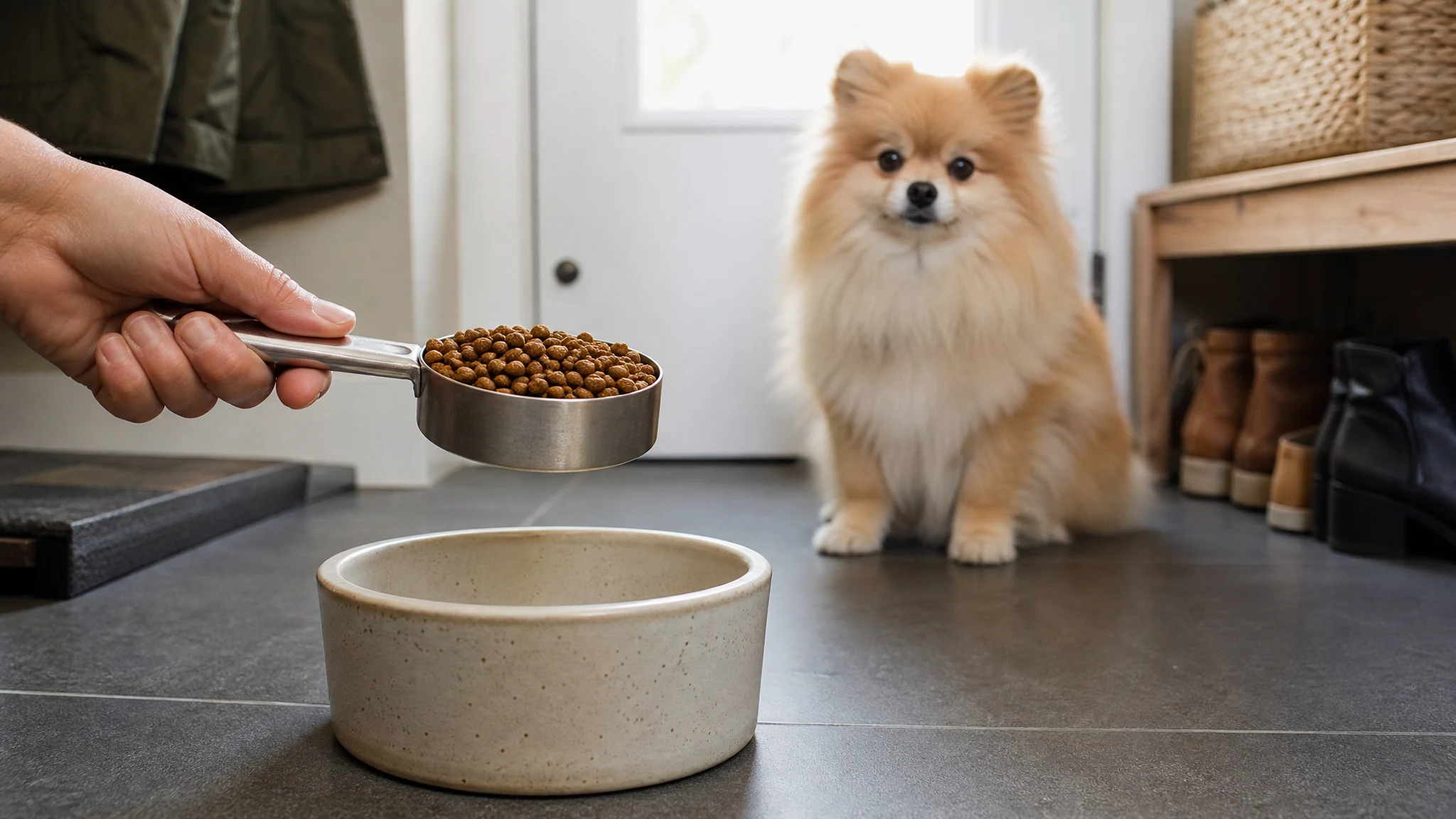
General nutrition information compiled from product labels and published sources, not veterinary advice. Your veterinarian is the right person to choose a diet for your dog, especially one with a health condition.
Most food bags print a dog feeding chart by weight and age. For a Pomeranian, that chart is only a starting point. The weight rows on many charts begin at 2 or 5 pounds, and the amounts are rounded to a quarter cup. For a dog that is small, a small error is a big percentage of a meal.
This guide shows how to read a label chart, adjust it for a toy-size dog, and check whether the plan is working. We compared label data from brand pages. We did not run feeding trials or taste tests, and nothing here replaces your veterinarian's advice.
What You Need
- The food you actually feed, with the bag or the brand's product page open to the feeding guide.
- A kitchen scale that reads in grams. Cup scoops vary from person to person, and grams are more consistent.
- A standard measuring cup, if you prefer cups.
- A notebook or phone note for your dog's weight, meals, treats and body condition.
- Your veterinarian's contact details, for any question about a health condition.
Step 1: Confirm Your Dog's Weight and Life Stage
PetMD lists an adult Pomeranian at about 3 to 7 pounds. Other sites give different ranges, so your own dog's weight matters more than any breed average. Weigh your dog on a baby or kitchen scale, or at the vet's office. Write the number down.
Then pick the life stage. PetMD advises feeding adult food to dogs at least 1 year old. Before that, use a puppy food, or an all life stages food if the label says so. Dogs aged 7 and over may be offered a senior formula, though that is a conversation to have with your vet.
Step 2: Find the Right Chart on the Label
Use the chart on the food you actually feed. A chart from one brand does not carry over to another, because foods differ in calories per cup. The brand pages below show how much that varies.
| Food (brand page data) | Life stage | Calories listed | Example from the label chart |
|---|---|---|---|
| Royal Canin Pomeranian Adult Dry | Adult | 352 kcal per cup | 2.2 lb dog, low activity: 1/4 cup (24 g) per day |
| Hill's Science Diet Puppy Small & Mini Dry | Puppy | 418 kcal per cup | 2 lb dog, 4 to 9 months: 3/8 cup (40 g) per day |
| Hill's Science Diet Adult 7+ Small & Mini Dry | Senior | 359 kcal per cup | Chart runs from 1/4 cup for a 2 lb dog to 1 2/3 cups for a 25 lb dog |
| VICTOR Hi-Pro Plus Small Breed Adult | All life stages | 360 kcal per cup | 5 lb dog: 0.5 cup per day, using an 8 oz measuring cup |
| Freshpet Vital Small Breed Chicken Recipe | All life stages | 294 kcal per cup | 5 to 10 lb dogs: 1/2 to 3/4 cup per day |
These are examples of how label charts are written, not a Pomeranian chart. Notice that a cup of one food has more calories than a cup of another. Some pages also say only that you should use a feeding calculator, so check the brand's own page for your dog's weight.
Royal Canin lists its Small Puppy formula for dogs expected to reach 9 to 22 pounds as adults. A Pomeranian is usually lighter than that, so its X-Small line may fit better. Ask your vet which life-stage food suits your puppy.
Step 3: Pick a Starting Amount
- Find your dog's current weight in the label chart.
- Read across to the activity level, if the chart has one. Many Pomeranians are indoor companions, but activity differs from dog to dog.
- If your dog falls between two rows, start with the lower row and watch body condition. Do not round up by habit.
- Write the amount in grams if the chart gives grams. If it gives only cups, level the cup and do not heap it.
Treat this number as a starting point. The Hill's pages say to adjust amounts as needed to maintain optimal weight and to ask your veterinarian if you are unsure. That advice applies to any brand.
Step 4: Split the Daily Amount Into Meals
PetMD notes that Pomeranians have a higher than average risk of hypoglycemia, or low blood sugar, especially as puppies. It recommends a high-quality food that meets AAFCO standards and frequent meals. It says puppies get multiple meals a day, and adults and seniors get two to three.
The breed information site pomeranian.org says most puppy hypoglycemia cases come from insufficient or low-quality food. So a puppy should not skip meals or be put on a strict schedule meant for an older dog.
Divide the daily total by the number of meals and weigh each one. If you feed a puppy four times a day, each portion is a quarter of the total.
If a puppy seems weak, wobbly or unusually sleepy, call your veterinarian promptly. Do not wait for the next meal to see what happens.
Step 5: Count Treats and Toppers
PetMD advises that treats, chews and toppers count toward daily calories. For a dog this small, one dental chew or a few training treats can be a meaningful share of the day.
If your dog gets treats, take a little out of the meals to make room. Keep the treats tiny, and track them in your notebook with the meals.
Step 6: Check the Plan Every Two to Four Weeks
Weigh your dog on the same scale, at about the same time of day. Look at body shape from above and from the side. You should be able to feel the ribs under a light coat of fat, and see a waist from above. A Pomeranian's thick coat can hide weight gain, so use your hands as well as your eyes.
- Weight and shape steady: keep the amount.
- Gaining or ribs hard to feel: reduce slightly and recheck, or ask your vet.
- Losing weight without a plan: call your vet before changing anything.
For puppies, expect to move up the chart as weight grows. Check the chart again whenever your puppy's weight changes noticeably, or when you switch from a puppy to an adult food.
Step 7: Switch Foods Slowly
If you change brands or life stage, remember that calories per cup differ. A cup of a new food may carry more or fewer calories than the old one. Redo steps 2 and 3 with the new label. A gradual mix of old and new food over several days is a common approach, and your vet can suggest a schedule for your dog.
Common Mistakes to Avoid
- Using a large-breed chart or a generic chart. A chart that starts at 10 pounds does not describe a 5 pound dog.
- Eyeballing scoops. A heaped scoop can hold much more than a level one. Weigh the food when you can.
- Forgetting treats. They count toward daily calories.
- Leaving out meals for a puppy. Frequent meals matter for this breed, according to PetMD.
- Treating label amounts as fixed. They are a guide, and dogs differ.
- Switching to a food because of a health claim. No food chart can diagnose or treat a condition, and a prescription diet is something only a veterinarian prescribes.
Dogs With Health Conditions
PetMD lists dental disease and collapsing trachea among Pomeranian health problems. Extra weight is not the cause of either, but it can make a dog's life harder, so keeping an eye on body condition is sensible. If your dog has any diagnosed condition, or is on medication, confirm the amounts and meal schedule with your veterinarian before you rely on a label chart.
Questions about grain-free diets and heart disease come up often. The FDA's most recent public update on its investigation into diets and canine dilated cardiomyopathy is dated December 23, 2022, and the agency says it does not plan further updates until there is meaningful new scientific information. Your veterinarian can help you weigh any food choice for your own dog.
What to Expect
If the amount is about right, many owners find that their dog's weight stays steady and meals are finished without fuss. A healthy body shape, steady energy and normal stools are all signs that the plan may be working. Results vary by dog, and a few weeks of notes will tell you more than a single weigh-in.
For a broader look at portions across life stages, see our guide to how much to feed a Pomeranian by age.
Quick Recap
- Weigh your dog and confirm life stage.
- Use the chart for the exact food you feed.
- Start at the lower row if your dog falls between two.
- Split the total into the number of meals your vet recommends.
- Subtract treats from the day's food.
- Recheck weight and body shape every few weeks, and adjust in small steps.
Sources
- PetMD: Pomeranian breed page
- pomeranian.org: Pomeranian breed information
- FDA Center for Veterinary Medicine: Investigation into Potential Link between Certain Diets and Canine Dilated Cardiomyopathy
- Royal Canin: Pomeranian Adult Dry Dog Food
- Royal Canin: Small Puppy Dry Dog Food
- Hill's Pet: Science Diet Puppy Small & Mini
- Hill's Pet: Science Diet Adult 7+ Small & Mini
- VICTOR: Hi-Pro Plus Small Breed Adult
- Freshpet: Vital Small Breed Chicken Recipe