Best Dog Food Brands for Pomeranians: What Changes From Puppy to Senior
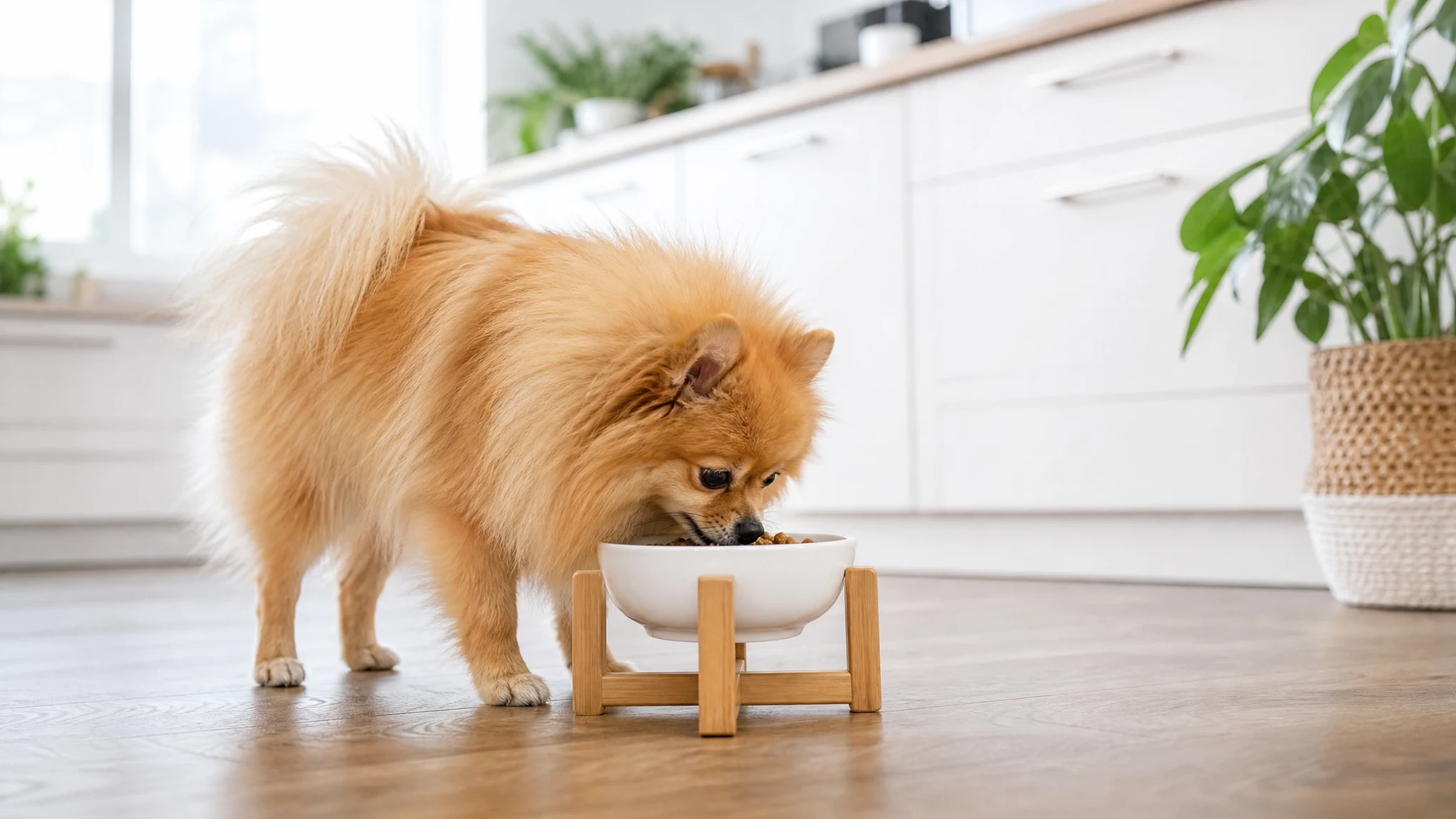
General nutrition information compiled from product labels and published sources, not veterinary advice. Your veterinarian is the right person to choose a diet for your dog, especially one with a health condition.
A Pomeranian eats very little, so every scoop counts. PetMD lists the adult weight at 3 to 7 pounds. At that size, a small label difference can matter at every life stage.
This guide shows how to read labels and compare best dog food brands at each stage. It uses the brands' own product pages. We compared label data only. We did not run feeding trials or taste tests, and we are not ranking foods as winners.
What You Need Before You Start
- Your dog's current weight, from a kitchen scale or your vet's scale.
- Your dog's age, and a note on how active they are.
- The bag or can of the current food, so you can read the label.
- A standard measuring cup, or a gram scale if you want more precise portions.
- A notebook or phone note to record meals, treats and weight.
- Your veterinarian's contact details, for any dog with a health condition.
Step 1: Know What Is Different About the Breed
PetMD lists the Pomeranian as having a higher than average risk of hypoglycemia (low blood sugar). Its advice is a high-quality food that meets AAFCO standards, fed in frequent meals. Puppies get multiple meals a day. Adults and seniors get two to three.
PetMD also advises counting treats, chews and toppers toward daily calories to avoid obesity. It lists dental disease and collapsing trachea among the breed's health problems. Collapsing trachea is not caused by diet, but a lean dog puts less strain on the airway. No food prevents or treats any of these. Your veterinarian decides what is right for an individual dog.
Step 2: Check the AAFCO Statement First
Find the sentence that says the food meets AAFCO Dog Food Nutrient Profiles. It should name a life stage: growth, maintenance, or all life stages. A puppy needs growth or all life stages. An adult can eat maintenance or all life stages.
A Pomeranian is a toy breed, well under the 70 pound adult size that AAFCO uses as its large-size line. So the phrase "except for growth of large size dogs" is not a problem for this breed. Foods that cover large-dog growth are also fine, but they are not required.
Step 3: Compare Label Data, Not Marketing
Look at four things: the first five ingredients, protein and fat, calories per cup, and the feeding guide. Calories per cup matter most for a dog this small. A food with more calories per cup needs a smaller scoop.
Some brands list guaranteed minimums. Others, like Hill's Science Diet, list only dry matter averages. Those are not the same thing, so do not compare them side by side as if they were.
Step 4: Match the Food to the Life Stage
Puppy (up to about 1 year)
PetMD says to feed adult food from 1 year of age. Before that, choose a growth or all life stages food.
- Hill's Science Diet Puppy Small & Mini Chicken & Brown Rice lists 418 kcal per cup. Its dry matter averages are protein 28.9% and fat 19.7%. Its table lists 3/8 cup per day for a 2 pound dog at 4 to 9 months.
- VICTOR Hi-Pro Plus Small & Medium Breed Puppy lists minimums of 30% protein and 18% fat, and 383 kcal per cup. It is an all life stages food.
- Royal Canin Small Puppy lists 349 kcal per cup. It is aimed at puppies expected to reach 9 to 22 pounds as adults. A Pomeranian is usually smaller than that, so ask your vet whether the X-Small line fits better.
Adult (1 to about 7 years)
Here you can choose a breed or size formula, or a fresh food.
- Royal Canin Breed Health Nutrition Pomeranian Adult lists minimums of 24% protein and 14% fat, and 352 kcal per cup. Its first five ingredients are brewers rice, corn, chicken by-product meal, chicken fat and oat groats. For example, a 2.2 pound dog at low activity gets 1/4 cup on its table. The page does not give a kibble size in numbers.
- Royal Canin X-Small Adult is for dogs up to 8 pounds as adults. It lists 22% protein, 16% fat and 369 kcal per cup. Its page sends you to a feeding calculator.
- Hill's Science Diet Adult Small & Mini lists 357 kcal per cup. It is a chicken and brown rice recipe. Its label supports maintenance through AAFCO feeding tests.
- VICTOR Hi-Pro Plus Small Breed Adult lists 30% protein, 14% fat, 5% fiber and 360 kcal per cup. Its chart gives 0.5 cup daily for a 5 pound dog, using an 8 ounce measuring cup.
Fresh options appear on the brands' pages too. Freshpet Small Dog Bite Size Chicken lists 267 kcal per cup. Freshpet Vital Small Breed lists 294 kcal per cup and 1/2 to 3/4 cup per day for dogs of 5 to 10 pounds. Fresh foods hold more water, so the cup is bigger for the same calories. Nom Nom Chicken Cuisine and JustFoodForDogs Chicken & White Rice are not small breed formulas. Check their feeding guides with your vet before using them for a dog this small.
Senior (about 7 years and up)
PetMD gives a life expectancy of 12 to 16 years, so seniors can spend many years on one diet. Hill's offers two senior small breed foods:
- Adult 7+ Small & Mini dry lists 359 kcal per cup and a nibble size kibble. Its chart starts at 1/4 cup for a 2 pound dog.
- Adult 7+ Small & Mini canned lists 174 kcal per 5.8 ounce can. That is per can, not per cup. Its sample amounts start at 1/2 can for a 2 pound dog.
Dental disease is on PetMD's list for the breed. A softer wet food may be easier to chew, but ask your vet about your dog's mouth before switching.
Step 5: Set the Portion and the Schedule
Start with the amount on the label for your dog's weight, then adjust by body condition. Treat the label as a starting point. Our Pomeranian feeding chart by age covers amounts and meal timing in more detail.
Split the day's food into several meals. PetMD suggests multiple meals for puppies and two to three for adults and seniors. Take the treats out of the daily total before you fill the bowl.
If your dog has a health condition, confirm the amount with your vet before you set a portion. Any prescription diet is something only a veterinarian prescribes.
Step 6: Switch Foods Slowly
Mix a little of the new food into the old food. Increase the new share over about a week. For a dog this small, a sudden switch can upset the stomach, and a skipped meal is a bigger concern for a breed prone to low blood sugar. If your dog stops eating, call your vet.
Tips and Common Mistakes
- Do not copy the cup amount from a big dog's chart. Use the row for your dog's weight.
- Do not skip the measuring. A heaping scoop of a 4 pound dog's food can be a large extra.
- Do not ignore treats. PetMD says they count toward daily calories.
- Do not compare protein numbers from different label types. A guaranteed minimum and a dry matter average are different measures.
- Do not read a grain-free label as safer or riskier on its own. The FDA's investigation into a possible link between certain diets and dilated cardiomyopathy (DCM) concerned grain-free diets high in peas, lentils or potatoes. Its latest update is dated December 23, 2022, and the agency does not plan more public updates until there is meaningful new science. Ask your vet about your dog.
- Do not rely on a small breed label alone. Check the AAFCO statement and the calories too.
- Check unknowns with the brand. Where a page does not state kibble size or a minimum, ask the brand directly.
What to Expect
A food that suits your dog may be linked with steady energy, regular stools and a stable weight. These signs can take several weeks to show, and they depend on many things besides food. Weigh your dog every few weeks and watch the waist. If weight changes, appetite drops or stools stay loose, talk to your vet instead of changing foods again.
Sources
- PetMD, Pomeranian breed page
- FDA CVM, Investigation into Potential Link between Certain Diets and Canine Dilated Cardiomyopathy
- Royal Canin, Pomeranian Adult product page
- Hill's Pet, Science Diet Adult Small & Mini product page
- VICTOR Pet Food, Hi-Pro Plus Small Breed Adult product page
- Freshpet, Small Dog Bite Size Chicken Recipe product page