Small-Breed Dog Food and Pomeranians: Why Kibble Size Matters
General nutrition information compiled from product labels and published sources, not veterinary advice. Your veterinarian is the right person to choose a diet for your dog, especially one with a health condition.
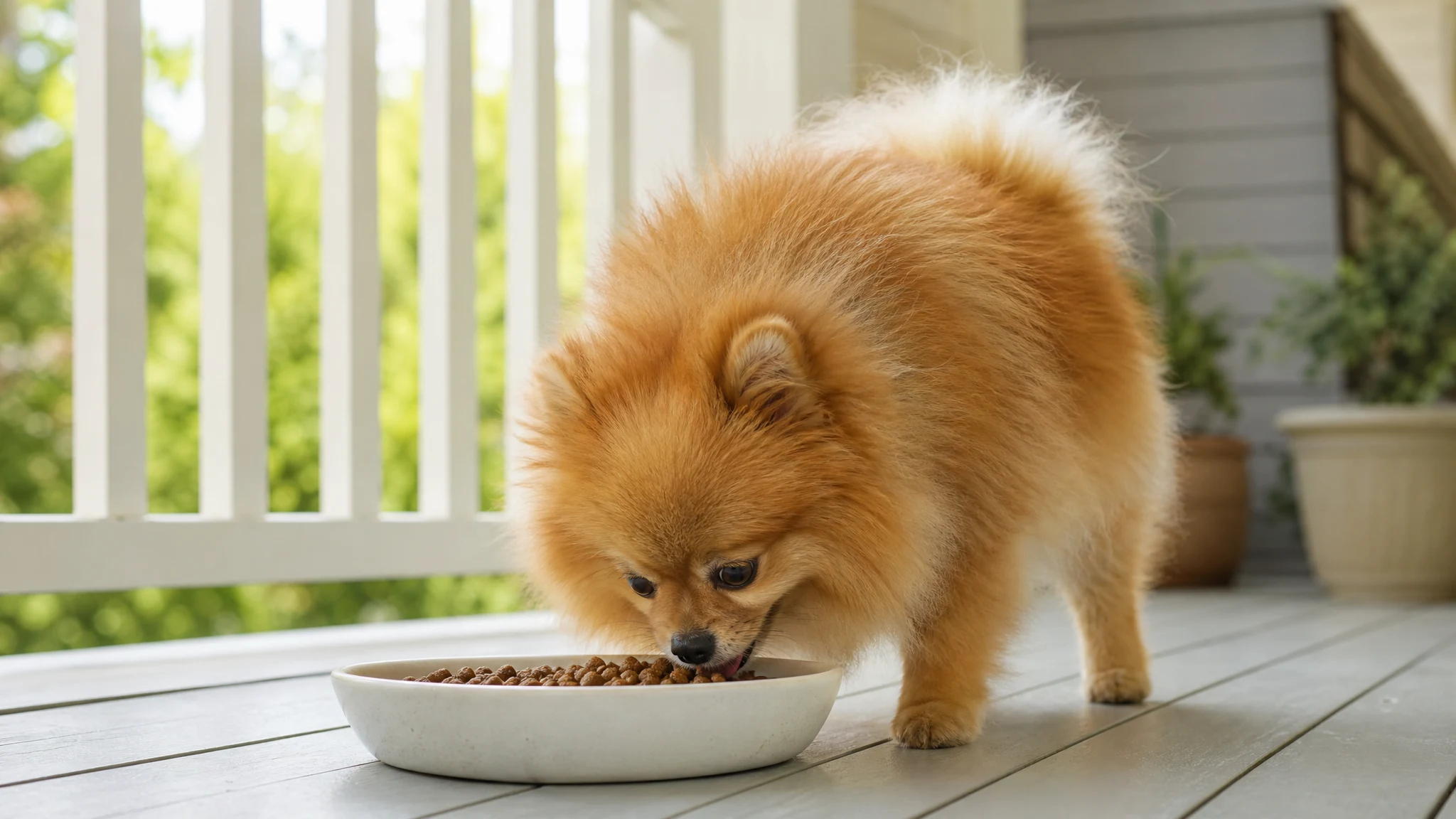
A Pomeranian is a tiny dog with a small mouth. PetMD lists the adult weight at 3 to 7 pounds. Kibble made for a 40 pound dog is a poor match for that mouth, and bag labels do not always tell you much about size.
This guide walks you through choosing and testing a small-breed food, step by step. It is built around the label details that are actually printed on the bag or the brand's product page. It is not a ranking of products.
A note on method: we compared label data from the brands' own pages. We did not run feeding trials or taste tests, and we have not fed any of these foods to dogs. Treat everything here as a way to read labels, not as a verdict on a food.
Why kibble size matters for a Pomeranian
Size is about more than looks. Pieces that are too large can be hard for a toy dog to pick up and chew. Pieces that are small and easy to handle make it simpler to measure out small meals.
Meal frequency matters too. PetMD notes the breed has a higher than average risk of hypoglycemia (low blood sugar), especially in puppies. It recommends a high-quality food that meets AAFCO standards, plus frequent meals. Puppies get several meals a day. Adults and seniors get two to three. A dog that struggles with its food may skip meals, which is one reason to pay attention to kibble size.
Teeth are another reason to watch eating habits. PetMD lists dental disease among the breed's health problems. Kibble size does not prevent or treat dental disease. If your dog drops food, chews on one side or avoids meals, mention it to your veterinarian.
What you need before you start
- The bag or product page of your current food, with its ingredient list and nutrition statement.
- Your dog's current weight from a recent vet visit or a home scale.
- A kitchen scale or a standard measuring cup.
- A notebook or phone note to record meals, treats and stool quality.
- Your veterinarian's contact details, for questions about your dog's individual needs.
Step 1: Confirm your dog's life stage
Start with age. PetMD advises feeding adult food to dogs at least 1 year old. Younger dogs need a growth or all life stages food.
Be careful with puppy formulas labeled for "small breeds." Royal Canin's Small Puppy page gives an expected adult weight of 9 to 22 pounds. A Pomeranian at 3 to 7 pounds sits below that range. Royal Canin also makes an X-Small line for adult dogs up to 8 pounds. Ask your veterinarian which line fits your puppy.
Large-breed growth rules do not apply here. A Pomeranian is far under the 70 pound adult weight that the AAFCO statements use as their large-size cutoff.
Step 2: Look for a complete and balanced statement
Find the AAFCO statement on the label. It should say the food is formulated to meet AAFCO Dog Food Nutrient Profiles, or that it passed AAFCO feeding tests, for your dog's life stage. Brands word this differently:
- Royal Canin's Pomeranian Adult states it is formulated to meet the AAFCO profiles for maintenance.
- Hill's Science Diet small and mini adult foods say AAFCO feeding tests substantiate complete and balanced nutrition for adult maintenance.
- VICTOR's Hi-Pro Plus Small Breed Adult is formulated for all life stages, except growth of large size dogs.
If the statement is missing, skip the food and ask the brand or your veterinarian.
Step 3: Find out what the brand says about kibble size
This is the core step. Read the product page or bag for any wording about size. Do not assume a small-breed label means a particular size, because the pages we reviewed gave descriptions rather than measurements.
| Food | What the brand page says about size |
|---|---|
| Royal Canin Breed Health Nutrition Pomeranian Adult | Smaller kibble shape described as the right size for a small breed's petite jaws. No measurement given. |
| Royal Canin Size Health Nutrition X-Small Adult | Very small kibble for the miniature jaw of dogs under 8 pounds. No measurement given. |
| Hill's Science Diet Adult 7+ Small & Mini | Described as nibble size kibble. |
| VICTOR Hi-Pro Plus Small Breed Adult | Described as nutrient dense, bite-sized kibble. |
None of these pages gave a size in millimeters or inches. For an exact answer, contact the brand, or buy the smallest bag available and look at the pieces yourself.
Step 4: Compare calories and nutrients on the label
Small kibble is only useful if the food suits your dog. Compare the calorie figure and the nutrient numbers the brand publishes. The figures below are the ones the brands list for dry adult foods.
- Royal Canin Pomeranian Adult: 352 kcal ME per cup. Minimum protein 24%, minimum fat 14%, maximum fiber 3.6%.
- Royal Canin X-Small Adult: 369 kcal ME per cup. Minimum protein 22%, minimum fat 16%, maximum fiber 3.5%.
- Hill's Adult 7+ Small & Mini: 359 kcal per cup. Hill's gives dry matter averages (protein 21.5%, fat 15%, crude fiber 3.7%) rather than guaranteed minimums, so you cannot compare it directly with the others.
- VICTOR Hi-Pro Plus Small Breed Adult: 360 kcal per cup. Minimum protein 30%, minimum fat 14%, maximum fiber 5%.
Do not compare a minimum figure with a dry matter average. They measure different things. Also remember that a Pomeranian eats very little, so even small calorie differences per cup add up over weeks. Fresh and wet foods have much lower calories per cup because of their water content, so measure them by the brand's guide instead of swapping cup for cup.
Step 5: Read the first ingredients without over-reading them
Ingredient lists are in order by weight before cooking, and brands can split or combine ingredients in ways that make a list look better or worse. For example, Royal Canin's Pomeranian Adult lists brewers rice, corn, chicken by-product meal, chicken fat and oat groats first. Hill's lists chicken, brown rice, whole grain wheat, whole grain corn and brewers rice. VICTOR starts with beef, chicken meal, beef meal, brown rice and whole grain millet.
These lists describe what is in the bag. They do not tell you which food is healthier for your dog. If you have a concern about a specific ingredient, your veterinarian can help you weigh it.
On grain-free foods, the FDA's page on its dilated cardiomyopathy (DCM) investigation was last updated December 23, 2022. FDA says it does not plan more public updates until there is meaningful new science. The agency's page concerned diets high in peas, lentils or potatoes. Ask your veterinarian before choosing a grain-free formula.
Step 6: Use the feeding guide as a starting point
Brand charts are starting points, not prescriptions. Royal Canin's Pomeranian page gives, for example, 1/4 cup (24 g) per day for a 2.2 pound dog with low activity. Hill's adult 7+ chart runs from 1/4 cup for a 2 pound dog. VICTOR's chart lists 0.5 cup daily for a 5 pound dog, using a standard 8 ounce measuring cup.
Weigh the food on a scale when you can. A cup scoop can vary by several grams, which matters for a dog this small.
Count treats too. PetMD advises that treats, chews and toppers count toward daily calories, to help avoid obesity. Weight management also matters because collapsing trachea is listed among the breed's health problems. Your veterinarian can tell you what a healthy weight looks like for your dog.
For more on the other factors that shape a Pomeranian's diet, see Pomeranian nutrition: the diet factors that matter.
Step 7: Switch foods slowly
Do not change foods overnight. Mix a small amount of the new food into the old, and increase the share over about a week or more, unless your veterinarian gives a different schedule. Keep meals at the same times each day.
Do not skip meals during a switch. Because of the breed's hypoglycemia risk noted by PetMD, call your veterinarian promptly if your dog refuses food for a meal or more, especially a puppy.
Step 8: Watch and record
For the first few weeks, note how much your dog eats, how it handles the pieces, its stool quality, and its weight. Take the notes to your next vet visit.
Tips and common mistakes
- Assuming "small breed" means the right size. The wording varies, and a small-breed food may still be larger than a toy dog likes.
- Buying a big bag first. Start with the smallest bag in case your dog rejects it.
- Ignoring treats. Treats add calories quickly for a 5 pound dog.
- Comparing mismatched numbers. Minimums, maximums and dry matter averages are not interchangeable.
- Using puppy food too long. Move to an adult food around 1 year of age, after checking with your veterinarian.
- Using the feeding chart as a rule. Activity, age and health all change what a dog needs.
- Softening or changing kibble for dental problems on your own. Ask your veterinarian first.
What to expect
A well-matched food may make mealtimes easier, and your dog may eat more steadily. You may also find it easier to portion out small, frequent meals. Results vary by dog, and a food cannot be said to prevent or treat any condition, including low blood sugar, dental disease or weight problems. A veterinarian decides what is right for an individual dog, including whether any prescription diet is needed.
If your dog loses weight, vomits, has loose stools that last, or shows signs of low energy or weakness, stop experimenting and call your veterinarian.
When you are looking for the best dog food for small dogs, remember that the best choice is a complete and balanced food, in a size your Pomeranian can manage, fed in measured amounts, and confirmed with your veterinarian.
Sources
- PetMD, Pomeranian breed page
- FDA Center for Veterinary Medicine, investigation into diets and canine dilated cardiomyopathy
- Royal Canin, Breed Health Nutrition Pomeranian Adult
- Royal Canin, Size Health Nutrition X-Small Adult
- Royal Canin, Small Puppy
- Hill's Pet, Science Diet Adult 7+ Small & Mini
- VICTOR Pet Food, Hi-Pro Plus Small Breed Adult